Medical students put to the test in realistic patient cases
A bell rings, and the next patient case begins. In the ninth semester, medical students face the program’s most extensive OSCE, with ten stations testing their clinical judgment and practical patient management.
When medical student Anton Wöhrer has completed his OSCE, he is relieved to have the practical exam behind him. He describes the examination as both nerve-racking and relevant.
“It is very close to real life, and I actually think we should have more exams like this, although I understand how resource-intensive they are. The hardest part was the time pressure, especially taking a good medical history quickly. But it feels like very good preparation for clinical work,” says Anton, noting that he will put the experience to use almost immediately in his upcoming summer job as an assisting physician.
Safe patient care
OSCE, Objective Structured Clinical Examination, is a practical, case-based examination in a simulated clinical setting. This examination is part of the new medical program, which leads to professional licensure. In the ninth semester, the OSCE is an examination students must pass before they can begin semester 11.
“We want all students to succeed, and the vast majority pass without difficulty. But the examination has to be rigorous enough for us to feel confident that those who move forward have the clinical competence required,” says Sam Polesie, the examiner responsible for semester 9.
The semester 9 OSCE consists of ten active stations and six rest stations. At the active stations, students work through cases drawn from different parts of the health care system, from primary care to emergency and specialist care. At each station, they have two minutes to read the instructions and six minutes to manage the case.
Common and dangerous conditions
Like the medical program as a whole, the examination focuses on conditions that are common and conditions that are dangerous. It tests not only factual knowledge, but also clinical decision-making, prioritization, and communication with patients or colleagues.
“Students must be able to manage clinical situations independently in a way that is safe, patient-centered, and evidence-based. It is not just about arriving at the right diagnosis, but also about asking relevant questions, setting the right priorities, and knowing when to ask for help,” says Frida Strömberg Celind, the faculty member overseeing the OSCE.
The subject areas vary from one examination session to another, but may include emergency medicine, family medicine, anesthesiology and intensive care, infectious diseases, internal medicine, surgery, neurology, obstetrics and gynecology, pediatrics, psychiatry, ophthalmology, dermatology, and otolaryngology. Professional development is also given particular emphasis.
Six minutes in the room
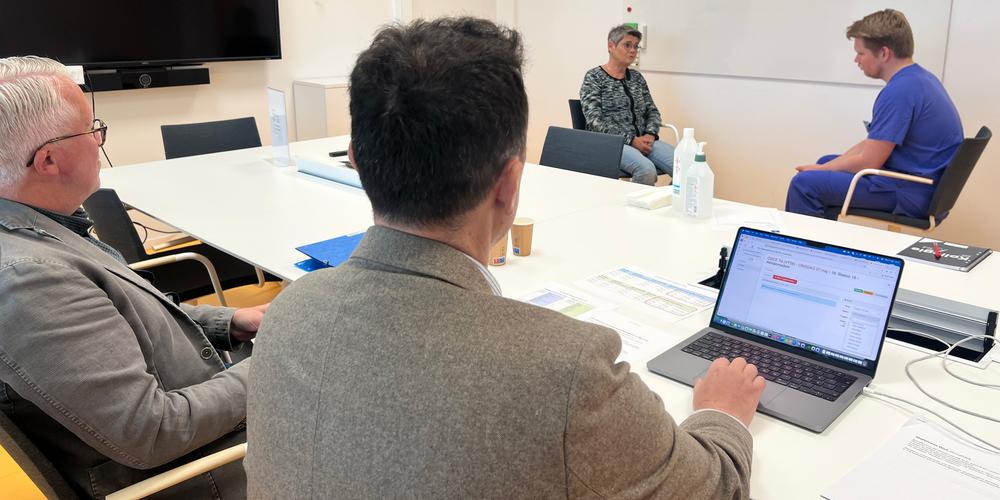
Each room has at least two assessors: a practicing physician and a teacher from the program. When needed, the assessors may offer limited guidance to help the student move forward, but without solving the task for the student. They then use digital protocols to indicate whether the student carries out the required steps. This may involve giving a relevant handoff to a senior physician, proposing the correct initial diagnosis, recommending further management and treatment, or taking a relevant medical history.
At each station, the student’s performance is assessed as a whole. Each station can yield up to ten points, and to pass on points, students must achieve roughly two-thirds of the maximum score.
“A student can clearly fail one of the stations and still pass the exam. But there is a difference between missing a step and making a decision that puts the patient at risk, such as sending home a patient with a suspected myocardial infarction. We also look at whether the student seemed to have a temporary mental block, or whether the mistake was part of a broader pattern,” says Sam Polesie.
A patient with a headache
In one of the rooms, simulated patient Carina Götesjö is seated. She plays a patient who visits a primary care clinic because of a persistent headache and is worried that it might be a brain tumor. The student’s task is to meet the patient, ask relevant questions, provide a clear response to the patient’s concerns, and assess the next step in management.
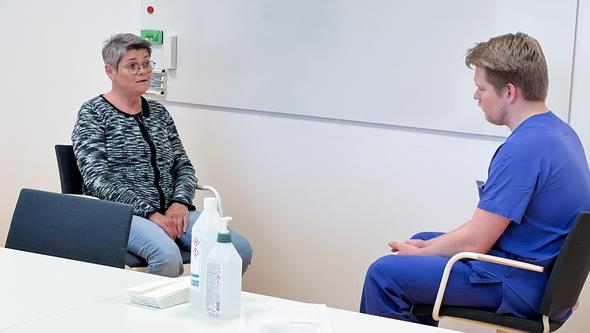
“I enjoy playing my role and meeting the students. But after a while, I start to feel like a parrot repeating the same things over and over,” says Carina Götesjö.
In the same room, the students’ performance is assessed by Bledar Daka, professor of family medicine, and Olle Vinensjö, a general practitioner at Billingen Primary Care Center in Skövde.
“You can tell that several of the students are under considerable pressure, and this is an exam carried out under significant time constraints. But overall, I think the students are very skilled despite the pressure,” says Olle Vinensjö.
After each student, the assessors compare their impressions, particularly when a performance is close to the passing threshold.
“We see what we need to see, and most of the time we agree in our assessment. There may be small differences when we summarize what we observed during the student’s encounter with the patient, but then we go through it together,” says Bledar Daka.
Extensive planning
To ensure consistent assessment, all assessors completed training before the OSCE. One new feature in this year’s examination was that assessors could also mark excellent performance at a station, even though the final grade for the examination remains pass or fail.
“For students, a mark of excellent performance can confirm that they have a high level of competence in a particular area. At the same time, the results provide important feedback to the course leadership: if many students struggle with a particular station, we may need to review the teaching,” says Frida Strömberg Celind.
The examination requires extensive coordination behind the scenes. It involves nearly 100 students, about 50 teachers and administrators, and many simulated patients who take part in the different stations.
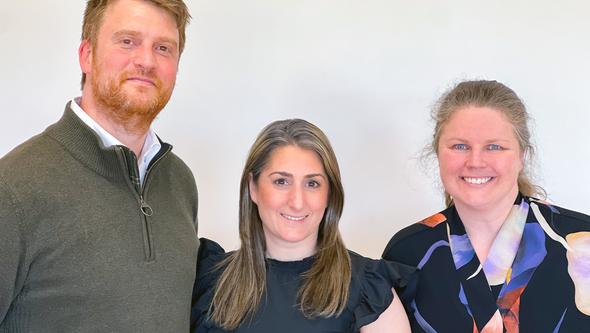
“OSCE is a major undertaking, with many people, rooms, and schedules to coordinate. It requires a great deal of preparation to make the flow work, and it is rewarding to see everything run as it should,” says Maria Mardini, OSCE coordinator at the Sahlgrenska Academy Office, University of Gothenburg.